

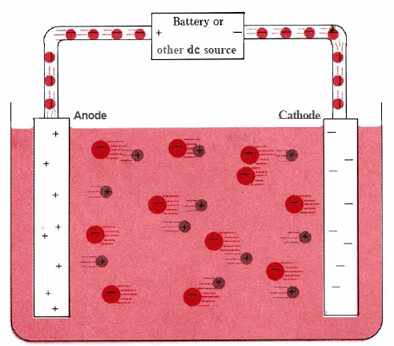
Electrolysis

8da9fbd8e9a9ed9fa2571b066ae3e484

An_Electrolytic_Cell

electrolysis is the passage of a direct electric current through an ion-containing solution. Electrolysis produces chemical changes at the electrodes.
In chemistry, the production of chemical changes by passing an electric current through a solution or molten salt (the electrolyte), resulting in the migration of ions to the electrodes: positive ions (cations) to the negative electrode (cathode) and negative ions (anions) to the positive electrode (anode). Continue reading

Nuclear Chemistry

The discovery of x-rays by William Conrad Roentgen in November of 1895 excited the imagination of a generation of scientists who rushed to study this phenomenon. Within a few months, Henri Becquerel found that both uranium metal and salts of this element gave off a different form of radiation, which could also pass through solids. By 1898, Marie Curie found that compounds of thorium were also “radioactive.” After pain-staking effort she eventually isolated two more radioactive elements–polonium and radium–from ores that contained uranium.
Continue reading