

Niels Henrik David Bohr
Born: 7 October 1885, Copenhagen, Denmark
Died: 18 November 1962, Copenhagen, Denmark
Affiliation at the time of the award: Copenhagen University, Copenhagen, Denmark
Prize motivation: “for his services in the investigation of the structure of atoms and of the radiation emanating from them”
Field: Theoretical nuclear physics
The Bohr’s Theory
The discoveries of the electron and radioactivity at the end of the 19th century led to different models for the structure of the atom. In 1913, Niels Bohr proposed a theory for the hydrogen atom based on quantum theory that energy is transferred only in certain well defined quantities. Electrons should move around the nucleus but only in prescribed orbits. When jumping from one orbit to another with lower energy, a light quantum is emitted. Bohr’s theory could explain why atoms emitted light in fixed wavelengths.
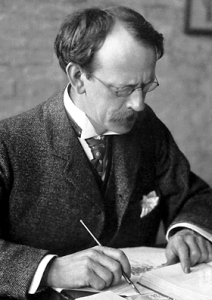
Joseph John Thomson
Born: 18 December 1856, Cheetham Hill, near Manchester, United Kingdom
Died: 30 August 1940, Cambridge, United Kingdom
Affiliation at the time of the award: University of Cambridge, Cambridge, United Kingdom
Prize motivation: “in recognition of the great merits of his theoretical and experimental investigations on the conduction of electricity by gases”
Field: Atomic physics
Experiments with Gases
The idea that electricity was transmitted by a charged smallest unit related to the atom was put forward in the 1830s. In the 1890s J.J. Thomson made experiments with charged particles in gases and managed to estimate its magnitude. In 1897 he showed that cathode rays, radiation emitted in a low pressure glass tube when a voltage is applied between two metal plates, consist of particles, electrons, that carry electricity. Thomson also concluded that electrons were part of the atom. 
Ernest Rutherford
Born: 31 August 1871, Nelson, New Zealand
Died: 19 October 1937, Cambridge, United Kingdom
Affiliation at the time of the award: Victoria University, Manchester, United Kingdom
Prize motivation: “for his investigations into the disintegration of the elements, and the chemistry of radioactive substances”
Field: Nuclear chemistry
Einstein family
From Wikipedia, the free encyclopedia
(Redirected from Maja Einstein)
Jump to: navigation, search
Einstein Family
Current region Jewish
Information
Place of origin Württemberg, Germany
Notable members Albert Einstein, Maja Einstein, Hermann Einstein, Pauline Koch
Connected families Koch, Moos, Overnauer , Clews
Einstein Family Tree
The Einstein family is the family of the famous scientist Albert Einstein. Einstein’s great-great-great-great-grandfather, Jakob Weil, is his oldest recorded relative, born around the turn of the 18th century, and the family continues to this day. Albert Einstein’s great-great-grandfather, Löb Moses Sontheimer (1745–1831), was also the grandfather of the prominent tenor Heinrich Sontheim (1820–1912) of Stuttgart.[1]
Albert’s three children were from his relationship with his first wife, Mileva Marić, his daughter Lieserl being born a year before they married.
Albert Einstein’s second wife was Elsa Einstein, whose mother Fanny Koch was the sister of Albert’s mother, and whose father Rudolf Einstein was the son of Raphael Einstein, a brother of Albert’s paternal grandfather. Thus Albert and Elsa were first cousins through their mothers and second cousins through their fathers.[2]
Contents
1 Einstein Family table
2 Pauline Koch (Albert’s mother)
2.1 Early life
2.2 Business problems
2.3 After Hermann
2.4 Death
3 Hermann Einstein (Albert’s father)
3.1 Early life
3.2 Marriage to Pauline
3.3 Work
3.4 Death
4 Maria “Maja” Einstein (Albert’s sister)
5 Lieserl Einstein (Albert’s daughter)
6 Abraham Einstein (Albert’s grandfather)
7 Ancestors and Relatives
7.1 Einsteins and Ainsteins
7.2 Daniel’s children
7.3 Leopold’s children
7.4 Abraham’s children
7.5 David’s children
8 Further reading
9 References
10 External links
11 Notes
Einstein Family table
Generation Paternal Maternal Comment chinken
First (known) generation Jakob Weil from Wallerstein (?) (father of Jüttle Sara)[1]
Second generation Juda from Nordstetten (?), Chaja [last name unknown] (?),
Hoyna Moses Sontheimer (1705-?), Gölla [last name unknown] (?)
Jakob Weil (?), Jüttle Sara Weil (1722–1808),
David Katz
Third generation David Veit Einstein (1713-1763) Samuel Obernauer (1744–1795), Judith Mayer Hill (1748-?)
Löb Samuel Dörzbacher (1757-?) Golies (1761-?)
Löb Moses Sontheimer (1745-?)
Jakob Simon Bernheimer (1756–1790), Leah Hajm (1753–1833)
Bernard (Beerle) Weil (1750–1840), Rösle Katz (1760–1826)
Fourth generation Naftali Einstein (1733-1801), Hayum Moos, Helene Steppach (1737-1790)
Fifth generation Rupert Einstein (1759–1834) Veit Hirsch (1763–1820) Rebekka Overnauer (1770–1843)
Hayum Moos (1788-?), Fanny Schmal (1792-?) Zadok Löb Dörzbacher (1783–1852), Blumle Sontheimer (1786–1856)
Sixth generation Abraham Einstein (1808–1868). Siblings: Hirsch Einstein [b.1799-?], Judith Einstein [b.1802-?], Samuel Rupert Einstein [b.1804-?], Raphael Einstein [b.1806-?], David Einstein [b.1810-?]),
Helene Moos (1814–1887, Siblings: None)
Julius Dörzbacher (1816–1895, Siblings: None),
Jette Bernheimer (1825–1886, Siblings: None)
Seventh generation Hermann Einstein (1847–1902). Siblings: August Ignaz Einstein (b. 1841-?), Jette Einstein (b. 1844-?), Heinrich Einstein (b. 1845-?), Jakob Einstein (b. 1850-?), Friederike Einstein (b. 1855-?) Pauline Koch (1858–1920). Siblings: Fanny Koch (1852–1926), Jacob Koch (?), Caesar Koch (?)
Eighth generation Albert Einstein (1879–1955), Maja Einstein (1881–1951) Albert’s wives: Mileva Marić (1875–1948), Elsa Einstein (1876–1936)
Ninth generation (Albert’s children) Lieserl Einstein (1902-?), Hans Albert Einstein (1904–1973), Eduard Einstein (1910–1965)
Tenth generation Bernhard Caesar Einstein (1930–2008), Klaus Martin (1933–1939); and Evelyn (1941–2011) adopted child)
Eleventh generation Thomas Martin Einstein (1955-), Paul Michael Einstein (1959-), Eduard Albert (Ted) Einstein (1961-), Mira Einstein-Yehieli (1965-), Charles Quincy Ascher (Charly) Einstein (1971-)
Pauline Koch (Albert’s mother)
Pauline Einstein (née Koch)
Pauline Koch.jpg
Pauline Einstein (née Koch)
Born February 8, 1858
Cannstatt, Württemberg
Died February 20, 1920 (aged 62)
Berlin, Germany
Residence Germany (1858-1895)
Italy (1896-1903)
Germany (1904-1920)
Nationality German
Religion Jewish
Spouse(s) Hermann Einstein
Children Albert Einstein and Maja Einstein
Parents Julius Derzbacher and Jette Bernheimer
Pauline Einstein (née Koch) (February 8, 1858 – February 20, 1920) was the mother of the physicist Albert Einstein. She was born in Cannstatt, Württemberg.[3] She was Jewish and had an older sister, Fanny, and two older brothers, Jacob and Caesar. Her parents were Julius Doerzbacher, who had accepted the family name Koch in 1842, and Jette Bernheimer. They had married in 1847. Pauline’s father was from Jebenhausen, now part of the city of Göppingen, and came from simple circumstances. Later he lived in Cannstatt and together with his brother Heinrich succeeded in making a considerable fortune in the corn trade. They even became “Royal Württemberg Purveyor to the Court”. Their mother was from Cannstatt and was a quiet and caring person.
Early life
Pauline Koch ca.1878.
At 18 years old, Pauline married the merchant Hermann Einstein who lived in Ulm. They got married in Cannstatt on August 8, 1876. After the marriage the young couple lived in Ulm, where Hermann became joint partner in a bed feathers company. Their son Albert was born on March 14, 1879. On the initiative of Hermann’s brother Jakob the family moved to Munich in the summer of 1880, where the two brothers together founded an electrical engineering company called [4] Einstein & Cie. The second child of Hermann and Pauline, their daughter Maria (called Maja), was born in Munich on November 18, 1881. Pauline Einstein was a very well educated and quiet woman who had an inclination towards the arts. When her duties in the household allowed it she was an assiduous and good piano player. She made Albert begin with violin lessons at the age of five.[5]
Business problems
The factory of Hermann and Jakob was moved to Pavia, Italy in 1894. Hermann, Maria and Pauline moved to Milan in the same year and one year later moved to Pavia. Albert stayed with relatives in Munich to continue his education there. The separation from her son was certainly difficult for Pauline. Due to poor business, the brothers had to abandon their factory in 1896. Though Hermann had lost most of their money, he founded (without his brother) another electrical engineering company in Milan. This time business was better. However, Hermann’s health had gone downhill, and he died of heart failure in Milan on October 10, 1902.
After Hermann
In 1903 Pauline went to live with her sister Fanny and her husband Rudolf Einstein, a first cousin of Hermann, in Hechingen, Württemberg. Fanny’s daughter Elsa was to become the second wife of Albert in 1919. In 1910 Pauline moved with her sister Fanny and her family to Berlin. She took on a job as housekeeper in Heilbronn, Württemberg in 1911. She lived with her brother Jacob Koch and his family in Zurich after 1914.
Death
During World War I, Pauline fell ill with cancer. In 1918, when visiting her daughter Maria and son-in-law Paul Winteler in Luzern, Pauline was taken to the sanatorium Rosenau, due to her illness. At the end of 1919, Albert took his terminally-ill mother out of the sanatorium in Luzern and brought her to Haberlandstrasse 5, Berlin to stay with him and his second wife Elsa, where she later died.
Hermann Einstein (Albert’s father)
Hermann Einstein
Hermann einstein.jpg
Hermann Einstein
Born August 30, 1847
Buchau, Kingdom of Württemberg
Died October 10, 1902 (aged 55)
Milan, Kingdom of Italy
Ethnicity Jewish
Citizenship Germany (1847-1894)
Italy (1894-1902)
Occupation Scientific utility salesman, Electrician
Spouse(s) Pauline Koch
Children Albert Einstein and Maja Einstein
Parents Abraham Einstein and Helene Moos
Hermann Einstein (August 30, 1847 – October 10, 1902) was the father of Albert Einstein.
Early life
Abraham and Helene Einstein
Hermann Einstein (also known as Hermann Moos) was born in Buchau, Württemberg to Abraham Einstein and Helene Moos (July 3, 1814–Aug. 20, 1887).
He had six siblings:
Raphael (Dec. 3, 1839-Jan. 15, 1842); male, Jette (Jan. 13, 1844-Jan. 7, 1905); female, Heinrich (Oct. 12, 1845-Nov. 16, 1877); male, August Ignaz (Dec. 23, 1849-Apr. 14, 1911); male, Jakob (Nov. 25, 1850–1912); male, Friederike “Rika” (Mar. 15, 1855-June 17, 1938); female.[6]
At the age of 14, Hermann attended the secondary school in the regional capital Stuttgart and was academically successful. He had a strong affection for mathematics, and would have liked to study in this or a related area, but as the financial situation of the family opposed further education, he decided to become a merchant and began an apprenticeship in Stuttgart.
Marriage to Pauline
Main article: Pauline Koch
Hermann married 18-year-old Pauline Koch in Cannstatt, Württemberg on August 8, 1876.[7] After their wedding, the young couple lived in Ulm, where Hermann became joint partner in the bed feathers shop of his cousins Moses and Hermann Levi. In Ulm, their son Albert was born on March 14, 1879. On the initiative of Hermann’s brother Jakob, the family moved to Munich in the summer of 1880. There the two brothers founded the electrical engineering company Einstein & Cie, with Hermann being the merchant and Jakob the technician. The second child of Hermann and Pauline, their daughter Maria (called Maja) was born in Munich on November 18, 1881.
Work
The Einsteins’ electrical firm manufactured dynamos and electrical meters based on direct current. They were instrumental in bringing electricity to Munich, the capital of a very Catholic Bavaria. In 1885, they won the contract that provided DC lights to illuminate the Oktoberfest for the first time. To young, impressionable Albert, this must have been the source of great pride, for at this time Albert was the only Jew in his Catholic Petersschule class.
To their dismay, the Einstein brothers eventually lost a bidding war for the electrification contract of Munich to Siemens, which promoted the modern alternating current. Their fortunes took a decidedly downward turn from there.
The two brothers moved their company to Pavia, Italy in 1894. Hermann, Pauline and Maja moved to Milan in the same year and one year later moved to Pavia. Albert stayed with relatives in Munich to continue his education there. Due to poor business, Hermann and Jakob had to abandon their factory in 1896. Though Hermann had lost most of their money, he founded another electrical engineering company in Milan, this time without his brother. He was supported financially by his relatives in this venture. Though business was better this time, Hermann was preoccupied with “worries due to the vexatious money”. He moved back to Germany in 1902.
Death
Hermann Einstein died of heart failure in Milan,1902. The grave is Civico Mausoleo Palanti inside Cimitero Monumentale di Milano
Maria “Maja” Einstein (Albert’s sister)
Maria ‘Maja’ Einstein
Maja Einstein.jpg
Maria ‘Maja’ Einstein ca.1930
Born Maria Einstein
November 18, 1881
Munich, Germany
Died June 25, 1951 (aged 69)
Princeton, New Jersey, USA
Cause of death Atherosclerosis
Residence Germany (1881-1894)
Italy (1894-1902, 1922-1939)
Switzerland (1902-1922)
United States (1939-1951)
Nationality American
Occupation Doctor
Known for Alberts well known inventions
Religion Jewish
Partner(s) Paul Winteler
Children None
Parents Hermann Einstein and Pauline Koch
Relatives Albert Einstein
Notes
“Yes, but where does it have its small wheels?” Question by a young Albert Einstein when he first saw his sister in 1881.
Maria “Maja” Einstein and her older brother Albert Einstein were the two children of Hermann Einstein and Pauline Einstein (née Koch), who had moved from Ulm to Munich in June 1880, when Albert was two.[8] There Hermann and his brother Jakob had founded Einstein & Cie., an electrical engineering company.[9]
Maja and Albert, ca.1885
Maja and Albert, ca. 1891
She was born November 18, 1881 in Munich. When little Albert saw his sister for the first time he thought she was a kind of toy and asked: “Yes, but where does it have its small wheels?”[9] Maja and Albert got along very well all their lives. She was Albert’s only friend during his childhood.
She attended elementary school in Munich from 1887 to 1894. She then moved with her parents to Milan, where she attended the German International School; Albert had stayed behind with relatives in Munich to complete his schooling. From 1899 to 1902, she attended a workshop for teachers in Aarau. After she passed her final exams she studied Romance languages and literature in Berlin, Bern and Paris. In 1909, she graduated from University of Bern, her dissertation was entitled “Contribution to the Tradition of the Chevalier au Cygne and the Enfances Godefroi”.
In the year following her graduation, she married Paul Winteler, but they were to be childless. The young couple moved to Luzern in 1911, where Maja’s husband had found a job. In 1922 they moved to Colonnata near Florence in Italy.[10]
After Italian leader Benito Mussolini introduced anti-Semitic laws in Italy, Albert invited Maja to emigrate to the United States in 1939 and live in his residence in Mercer Street, Princeton, New Jersey. Her husband was denied entry into the United States on health grounds.[9] Maja spent some pleasant years with Albert, until she suffered a stroke in 1946, and became bedridden.[11] She later developed progressive arteriosclerosis, and died in Princeton on June 25, 1951 four years before her brother.[11]
Einstein family
Einstein Family.jpg
About this image
Hermann Einstein (top); Albert Einstein and Maja Einstein (bottom left); Pauline Koch (bottom right)
v
t
e
Lieserl Einstein (Albert’s daughter)
Lieserl Einstein
Born January 1902
Novi Sad, Vojvodina, Austria-Hungary (present day Republic of Serbia)
Died 1903?
Cause of death possibly scarlet fever
Resting place unknown
Residence Novi Sad (1902-19??)
Parents Mileva Marić and Albert Einstein
Relatives Marija Marić née Ružić, Miloš Marić, Pauline Einstein née Koch, Hermann Einstein, Hans Albert Einstein and Eduard Einstein.
Lieserl Einstein (born January, 1902 – last mentioned in 1903; date of death unknown) was the first child of Mileva Marić and Albert Einstein.
According to the correspondence between her parents, “Lieserl” was born in January, 1902, a year before her parents married, in Novi Sad, Vojvodina, present day Republic of Serbia, and was cared for by her mother for a short time while Einstein worked in Switzerland before Marić joined him there without the child.
“Lieserl’s” existence was unknown to biographers until 1986, when a batch of letters between Albert and Mileva was discovered by Hans Albert Einstein‘s daughter Evelyn.
Marić had hoped for a girl, while Einstein would have preferred a boy. In their letters, they called the unborn child “Lieserl”, when referring to a girl, or “Hanserl”, if a boy. Both “Lieserl” and “Hanserl” are diminutives of the common German names Liese and Hans.
The first reference to Marić’s pregnancy is found in a letter Einstein wrote to her from Winterthur, probably on May 28, 1901 (letter 36), asking twice about “the boy” and “our little son”,[12] whereas Marić’s first reference is found in her letter of November 13, 1901 (letter 43) from Stein am Rhein, in which she refers to the unborn child as “Lieserl”.[13] Einstein goes along with Marić’s wish for a daughter, and refers to the unborn child as “Lieserl” as well, but with a sense of humour as in letter 45 of December 12, 1901 “… and be happy about our Lieserl, whom I secretly (so Dollie [14] doesn’t notice) prefer to imagine a Hanserl.”[15]
The child must have been born shortly before February 4, 1902, when Einstein wrote: “… now you see that it really is a Lieserl, just as you’d wished. Is she healthy and does she cry properly? […] I love her so much and don’t even know her yet!”[16]
The last time “Lieserl” is mentioned in their extant correspondence is in Einstein’s letter of September 19, 1903 (letter 54), in which he shows concern for her suffering from scarlet fever. His asking “as what is the child registered? [Adding] we must take precautions that problems don’t arise for her later” may indicate the intention to give the child up for adoption.[17]
As neither the full name, nor the fate of the child are known so far several theories about her life and death have been put forward:
Michele Zackheim, in her book on “Lieserl”, Einstein’s Daughter, states that “Lieserl” was mentally challenged at birth, and that she lived with her mother’s family and probably died of scarlet fever in September 1903.[18]
Another possibility, favoured by Robert Schulmann of the Einstein Papers Project, is that “Lieserl” was adopted by Marić’s close friend, Helene Savić, and was raised by her and lived under the name “Zorka Savić” until the 1990s. Savić did in fact raise a child by the name of Zorka, who was blind from childhood and died in the 1990s. Her grandson Milan Popović rejects the possibility that it was “Lieserl”, and also favors the theory that the child died in September 1903.[19]
Abraham Einstein (Albert’s grandfather)
Abraham Einstein (8 Apr 1808–21 Nov 1868), the son of Ruppert Einstein and Rebekha Overnauer, is the father of Hermann Einstein and grandfather of Hermann’s son, Albert. Abraham married Helene Moos, both German Jews, in April 1839 in Buchau. Together, they had several children:
Raphael (3 Dec 1839–15 Jan 1842), male
Jette (13 Jan 1844–7 Jan 1905), female
Heinrich (12 Oct 1845–16 Nov 1877), male
Hermann (30 Aug 1847–10 Oct 1902), male
August Ignaz (23 Dec 1849–14 Apr 1911), male
Jakob (25 Nov 1850–1912), male
Friederike “Rika” (15 Mar 1855–17 Jun 1938), female
Ancestors and Relatives
Einsteins and Ainsteins
According to Geni.com First known is Baruch E/Ainstein (b. 1665 in Wangen as son of Moses Ainstein, Germany, d. after 1689), got married two times with unknown women, from one marriage he had Moyses Probabla E/Ainstein (b. 1689, d. 1732). Moyses got married two times, second marriage was with Judith Hayman, Judith got 2 stepson from this marriage: David Einstein (b. 1713 in Buchau, Germany, d. 1763, but there is also chance he is son of unknown son of Judith and Moyses) and Abraham Einstein, Moyses also had daughter from first marriage. Judith had 2 biological sons: Daniel Einstein (b. 1690 in Fellheim, Germany, d. after 1720) and Leopold Einstein (b. 1700, d. after 1718).
Daniel’s children
Daniel had 4 wives, but despite this he had only one child, either a son or stepson called Leopold (b. 1720 in Ulm, Germany, d. November 6, 1796 in Lupheim, Germany) -Descendent families: Einsteins, Bernheins, Bukas, Steiners, Nathans, Noerdlingers, Straussses, Saengers
Leopold’s children
Leopold had one wife called Karoline (b. 1700 in Buchau, Germany) and had: Abraham (b. January 12, 1718 in Buchau, Germany, d. June 16, 1787) -Descendent families: Guggenheims and Einsteins
Abraham’s children
Abraham had one unknown wife: Joseph (b. 1726 in Sontheim, Germany, d. April 29, 1795 in Jebenhausen, Germany) -Descendent families: Lindauer, Rohrbacher, Weils, Einsteins, Lindauers, Kohns, Levis, Fellheimers, Franks, Lindauers, Heumanns Sulzbergs, Katzs and Wormsers
David’s children
From marriage with Karoline Ehrlich he had: Moyses Naphatali (b. 1733 in Buchau, Germany, d. 1799) (Einstein’s GreatGreatGrandfather), his is grandfather of Abraham above, whom had been the Spouse of Greta.
Further reading
Albert Einstein, Mileva Marić: The Love Letters. Edited by Jürgen Renn & Robert Schulmann. Translated by Shawn Smith. Princeton University Press, Princeton, N.J. 1992, ISBN 0-691-08760-1
Michele Zackheim, Einstein’s Daughter: the Search for Lieserl, Riverhead 1999, ISBN 1-57322-127-9.
References
Highfield, Roger; Carter, Paul (1993). The Private Lives of Albert Einstein. London: Faber and Faber. ISBN 0-571-17170-2.
Wikimedia Commons has media related to: Einstein Family
External links
Lieserl Einstein’s Biography from einstein-website.de
Pauline Koch’s fact file from einstein-website.de
Notes
^ a b Aron Tanzer (1988). Die Geschichte der Juden in Jebenhausen und Göppingen (The History of Jews in Jebenhausen and Göppingen). Weissenhorn, Germany: Anton H. Konrad Verlag. pp. 220, 301, 334, 378, 383.
^ Short life history: Elsa Einstein.
^ Short life history: Pauline Einstein
^ Schwartz, Joseph. Introducing Einstein. ISBN 1-84046-667-7.
^ Botstein, Leon; Galison, Peter; Holton, Gerald James; Schweber, Silvan S. Einstein for the 21st Century: His Legacy in Science, Art, and Modern Culture, Princeton Univ. Press (2008) pp. 161-164
^ http://www.einstein-website.de/biographies/print/p_hermann.html http://www.einstein-website.de/biographies/print/p_hermann.html
^ Pauline Koch, Wikipedia page
^ http://www.einstein-website.de
^ a b c Short life history: Maria Winteler-Einstein
^ Highfield 1993, p. 203
^ a b Highfield 1993, p. 248
^ Albert Einstein, Mileva Marić: The Love Letters, Princeton, N.J. 1992, p. 54
^ Albert Einstein, Mileva Marić: The Love Letters, Princeton, N.J. 1992, p. 63
^ the english translation of the german “Doxerl”, one of the names Einstein used for Marić
^ Albert Einstein, Mileva Marić: The Love Letters, Princeton, N.J. 1992, p. 66
^ Albert Einstein, Mileva Marić: The Love Letters, Princeton, N.J. 1992, p. 73
^ Albert Einstein, Mileva Marić: The Love Letters, Princeton, N.J. 1992, p. 78
^ Lieserl Einstein’s biography
^ Milan Popović: In Alberts Shadow. The life and letters of Mileva Marić, Einstein’s first wife, Johns Hopkins University Press, London 2003, p.11, ISBN 978-0-8018-7856-5
Scientific
career
Special relativity
General relativity
Mass–energy equivalence
Brownian motion
Photoelectric effect
Einstein solid
Equivalence principle
Einstein field equations
Einstein radius
Einstein relation (kinetic theory)
Cosmological constant
Bose–Einstein condensate
Bose–Einstein statistics
Bose–Einstein correlations
Einstein–Cartan theory
Einstein–Infeld–Hoffmann equations
Einstein–de Haas effect
EPR paradox
Bohr–Einstein debates
Unsuccessful investigations
Works
Annus Mirabilis papers (1905)
Investigations on the theory of Brownian Movement (1905)
Relativity: The Special and the General Theory (1916)
The World as I See It (1949)
Why Socialism? (1949)
Russell–Einstein Manifesto (1955)
Family
Pauline Koch (mother)
Hermann Einstein (father)
Maja Einstein (sister)
Mileva Marić (first wife)
Elsa Einstein (second wife)
Lieserl Einstein (daughter)
Hans Albert Einstein (son)
Eduard Einstein (son)
Bernhard Caesar Einstein (grandson)
Evelyn Einstein (granddaughter)
Einstein
Prizes
Albert Einstein Award
Albert Einstein Medal
Albert Einstein Peace Prize
Albert Einstein World Award of Science
Einstein Prize (APS)
Einstein Prize for Laser Science
 sciencejoint