

Category chemistry
The Chemistry of the Non metals

RADIOACTIVITY
Radioactivity
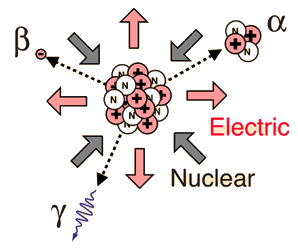
Radioactive decay rates are normally stated in terms of their half-lives, and the half-life of a given nuclear species is related to its radiation risk. The different types of radioactivity lead to different decay paths which transmute the nuclei into other chemical elements. Examining the amounts of the decay products makes possible radioactive dating. Radiation from nuclear sources is distributed equally in all directions, obeying the inverse square law.
|
|||||||
|
Go Back |
UNITS
Elements, Compounds, and Mixtures
Definitions of Acids and Bases and the Role of Water
Solutions
| Like Dissolves Like | Hydrophilic and Hydrophobic Molecules |
| Soaps, Detergents, and Dry-Cleaning Agents | Units of Concentration |
Like Dissolves Like
By convention, we assume that one or more solutes dissolve in a solvent to form a mixture known as the solution. The photographs that accompany this section illustrate what happens when we add a pair of solutes to a pair of solvents.
Gases
Energy, Enthalpy, and the First Law of Thermodynamics
Kinetic Molecular Theory
While the ideal gas law deals with macroscopic quantities of gas, the kinetic molecular theory shows how individual gas particles interact with one another. The kinetic molecular theory contains a number of statements compatible with the assumptions of the ideal gas law. It is worthwhile to list them here:
Continue reading
 sciencejoint