

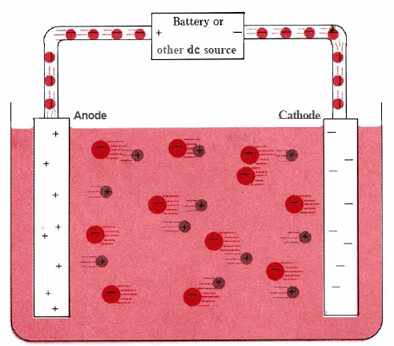
electrolysis is the passage of a direct electric current through an ion-containing solution. Electrolysis produces chemical changes at the electrodes.
In chemistry, the production of chemical changes by passing an electric current through a solution or molten salt (the electrolyte), resulting in the migration of ions to the electrodes: positive ions (cations) to the negative electrode (cathode) and negative ions (anions) to the positive electrode (anode).
During electrolysis, the ions react with the electrode, either receiving or giving up electrons. The resultant atoms may be liberated as a gas, or deposited as a solid on the electrode, in amounts that are proportional to the amount of current passed, as discovered by English chemist Michael Faraday. For instance, when acidified water is electrolysed, hydrogen ions (H+) at the cathode receive electrons to form hydrogen gas; hydroxide ions (OH-) at the anode give up electrons to form oxygen gas and water.
One application of electrolysis is electroplating, in which a solution of a salt, such as silver nitrate (AgNO3), is used and the object to be plated acts as the negative electrode, thus attracting silver ions (Ag+). Electrolysis is used in many industrial processes, such as coating metals for vehicles and ships, refining bauxite into aluminium, and the chlor-alkali industry, in which brine (sodium chloride solution) is electrolysed to produce chlorine, hydrogen, and sodium hydroxide (caustic soda); it also forms the basis of a number of electrochemical analytical techniques, such as polarography.
Faraday’s laws of electrolysis, in chemistry, quantitative laws used to express magnitudes of electrolytic effects, first described by the English scientist Michael Faraday in 1833. The laws state that (1) the amount of chemical change produced by current at an electrode-electrolyte boundary is proportional to the quantity of electricity used, and (2) the amounts of chemical changes produced by the same quantity of electricity in different substances are proportional to their equivalent weights. In electrolytic reactions, the equivalent weight of a substance is the gram formula weight associated with a unit gain or loss of electron. The quantity of electricity that will cause a chemical change of one equivalent weight unit has been designated a faraday. It is equivalent to 9.6485309 × 10⁴ coulombs of electricity. Thus, in the electrolysis of fused magnesium chloride, MgCl2, one faraday of electricity will deposit 24.312/2 grams of magnesium at the negative electrode and liberate 35.453 grams of chlorine at the positive electrode.
 sciencejoint